


The structural design
It’s called Vibrazione.
We engineered it not to vibrate.
Behind the lines there is an engineering calculation, not only a craftsman’s work. A 180 cm crystal top resting on twelve slender rods that cross in mid-air: before the first tube was cut, the base was modelled on a computer and calculated the way you would calculate a canopy or a floating staircase.
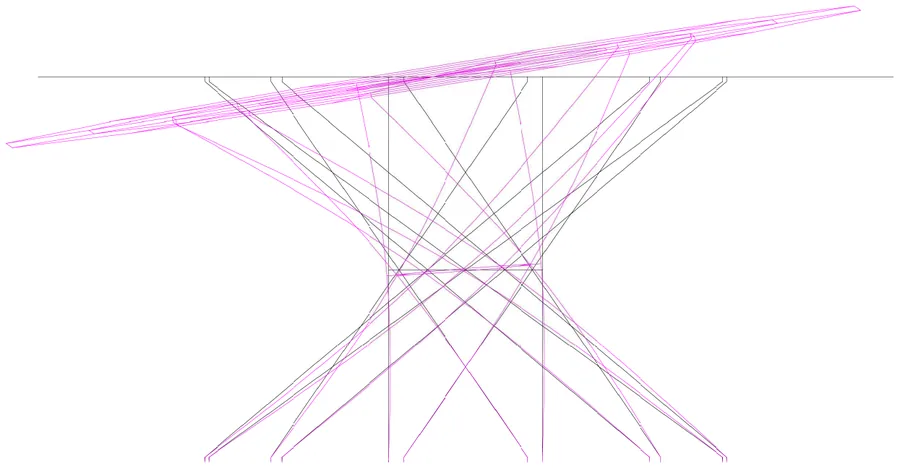
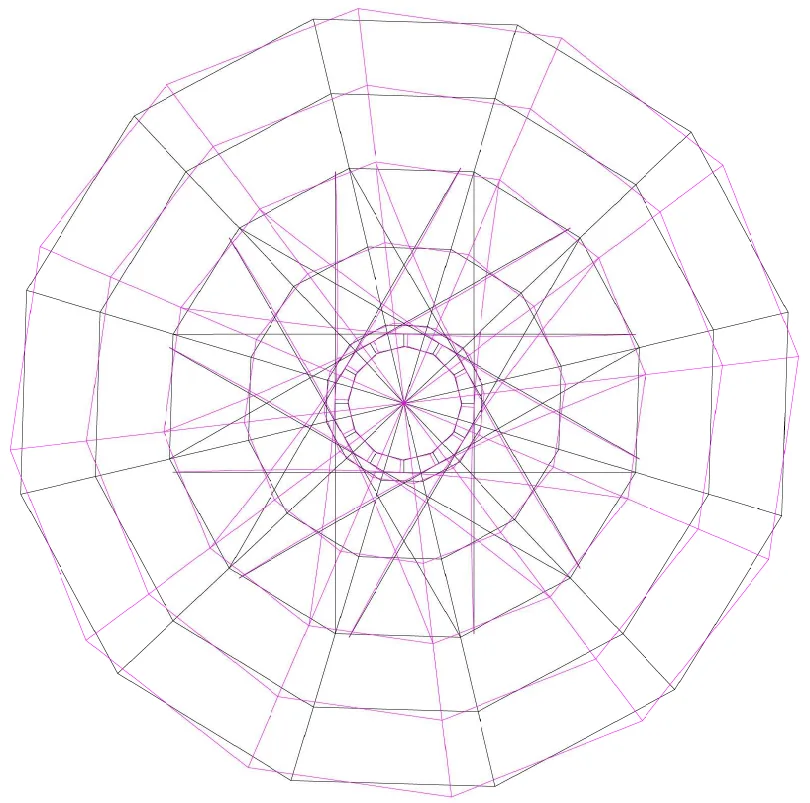
The finite element model checked every rod under load and studied the structure’s modes of vibration: in which direction it would move, and at what frequency, if someone pushed it. Below we show you those models.
In reality, even with a firm push on the edge, these movements stay below one millimetre. In the animation they are magnified about 100 times and slowed down 10 to 40 times.
Geometry
Twelve straight lines that draw a curve
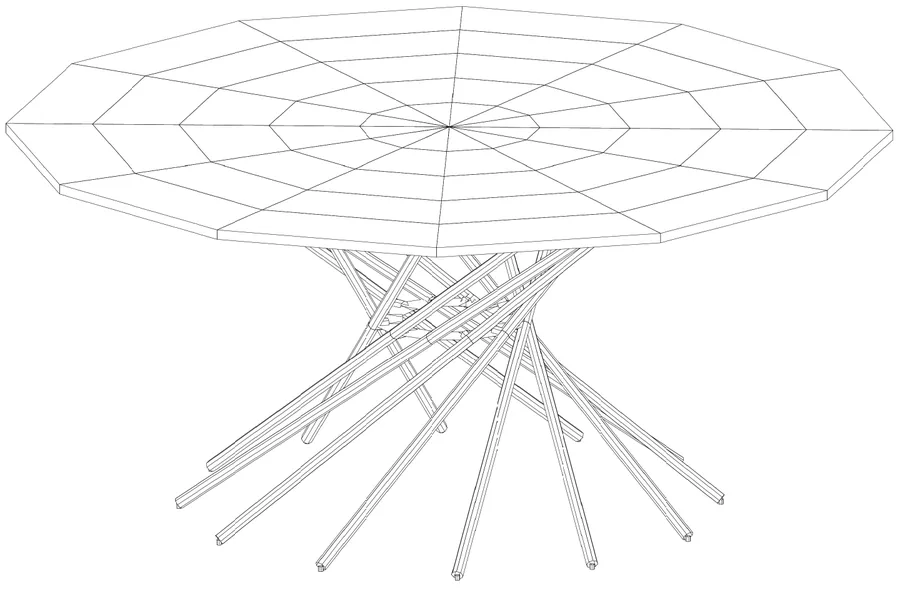
Every rod is straight. Put together, each one rotated 30° from the next, they describe a curved hourglass surface: a hyperboloid. It is the same geometry as the towers of the Russian engineer Vladimir Shukhov and as cooling towers: a shape built only from straight elements that becomes rigid precisely because of the way they cross.
At the centre the rods pass beside a steel disc, without meeting at a single point. That is where the play of lines that gives the table its name is born.
Behaviour
How it moves, and why you don’t feel it at the table
Every structure has frequencies at which it “prefers” to vibrate. If a repeated push arrives at exactly that frequency, the movement is amplified. For a table the real pushes are slow: footsteps on the floor, a leaning elbow, a chair being moved, almost always below 2–3 Hz.
The first mode of the Vibrazione is at 5.8 Hz, the vertical movement at 24 Hz. Both stay far from those pushes, and the crystal stays still. You see the energy of the lines; you don’t feel it in your glass.
For the technically minded
The numbers behind the calculation
Modal analysis: the first ten modes
| Mode | Period (s) | Frequency (Hz) | Movement | Participating mass |
|---|---|---|---|---|
| 1 | 0.173 | 5.77 | Torsion of the top | 10% vert. |
| 2 | 0.166 | 6.01 | Lateral, Y direction | 36% Y |
| 3 | 0.166 | 6.01 | Lateral, X direction | 36% X |
| 4 | 0.041 | 24.4 | Vertical | 77% vert. |
| 5 | 0.034 | 29.8 | Lateral, 2nd order, Y | 47% Y |
| 6 | 0.034 | 29.8 | Lateral, 2nd order, X | 47% X |
| 7 | 0.028 | 36.2 | Vertical, 2nd order | 7% vert. |
| 8–9 | 0.027 | 36.6 | Local modes of the rods | – |
| 10 | 0.018 | 56.6 | Vertical, 3rd order | 2% vert. |
With the first ten modes the calculation captures 94% of the mass horizontally and 96% vertically.
The Vibrazione Table is an original Mariani Design project: its shape, drawings and calculations are our property, which is why we do not publish its construction details. Copies and imitations are not authorised and are pursued through the appropriate legal channels.
